

On this page
- Important Disclaimer
- Introduction
- Why Your Brain Goes Into Overdrive
- Common Patterns of Nighttime Overthinking
- Immediate Techniques to Stop Overthinking
- Daytime Strategies to Prevent It
- When It's More Than a Sleep Problem
- How Professional Support Helps
- Creating a Sleep-Friendly Mindset
- When to Reach Out
Nighttime overthinking occurs because the brain defaults to processing unresolved worries when daytime distractions are removed. A 2020 meta-analysis in the Annals of Internal Medicine found Cognitive Behavioral Therapy for Insomnia (CBT-I) is more effective than sleep medication for long-term relief. Techniques such as 4-7-8 breathing, thought dumping before bed, and consistent sleep schedules significantly reduce racing thoughts.
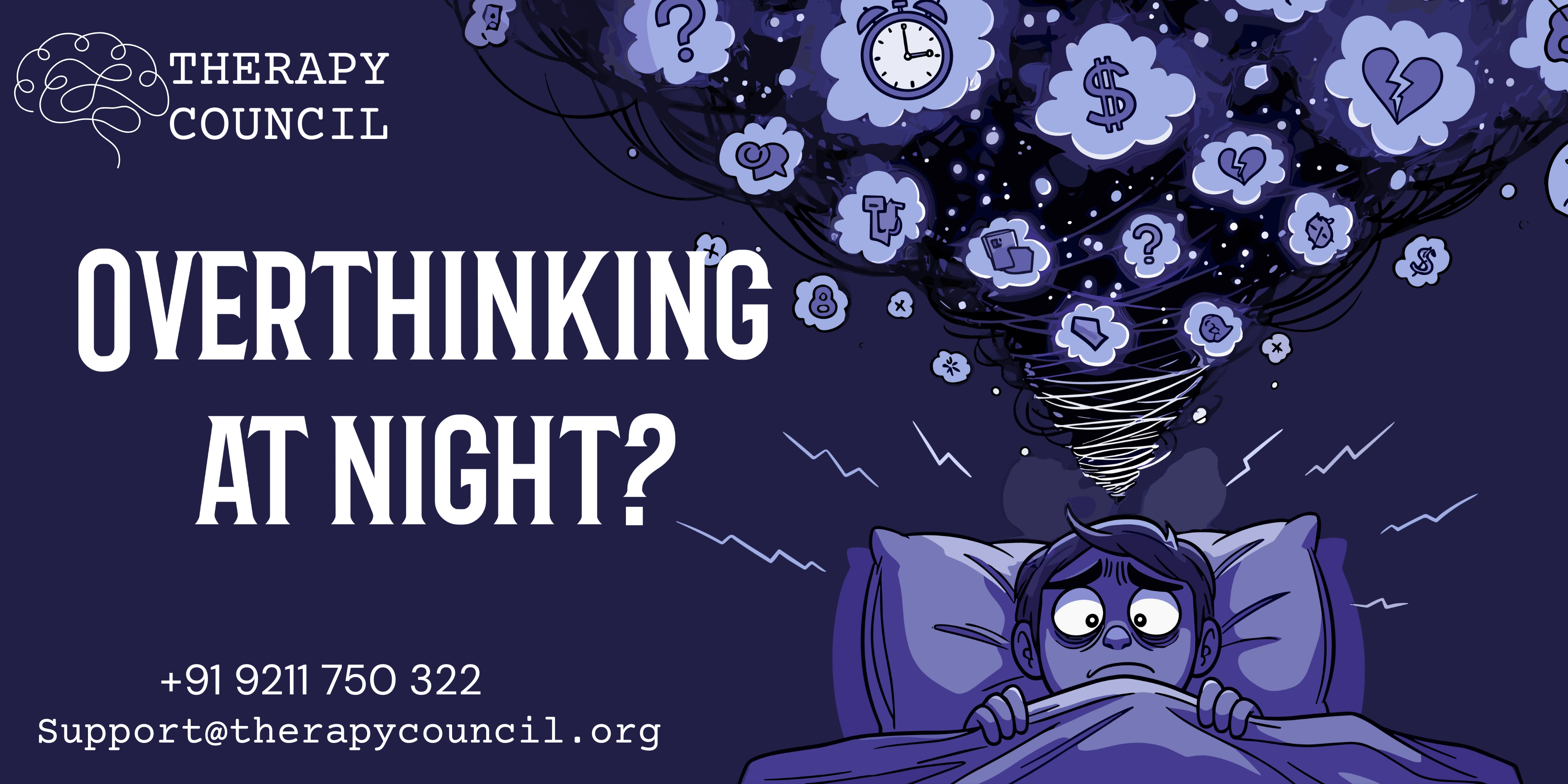
It's 2 AM. You're exhausted, but your brain won't stop. You replay that conversation from three days ago. You worry about tomorrow's presentation. You mentally write emails. You solve problems that don't need solving. You think about thinking too much. The harder you try to sleep, the more awake you become.
Sound familiar? You're not alone.
Nighttime overthinking isn't just annoying. It affects your sleep quality, mental health, productivity, and overall wellbeing.
But here's the good news: nighttime overthinking isn't permanent, and you're not powerless against it. Understanding why it happens and learning specific techniques can help you break the cycle and reclaim your sleep.
Why Your Brain Goes Into Overdrive at Night
Your nighttime overthinking isn't random. There are biological and psychological reasons why your mind races when you're trying to sleep.
The Science of Nighttime Rumination
When you lie down to sleep, external stimulation decreases. No phone notifications, no conversations, no tasks demanding attention. This creates a vacuum that your mind tries to fill.
Research published in Cognitive Therapy and Research (2019) found that reduced external stimulation at night increases internal focus, making worries and unresolved thoughts more prominent. Your brain, lacking external input, turns inward.
Additionally, cortisol (your stress hormone) naturally has a secondary peak in some people during late evening hours, particularly if you're chronically stressed. A 2020 study in Psychoneuroendocrinology found that people with anxiety show altered cortisol patterns, including evening elevation that fuels racing thoughts.
The Paradox of Trying to Sleep
The more you try to force sleep, the more stressed you become about not sleeping, which activates your stress response and makes sleep even harder. This creates a vicious cycle.
Sleep researchers call this "sleep effort." A 2018 study in the Journal of Clinical Sleep Medicine found that trying hard to sleep actually worsens insomnia symptoms. Your brain perceives sleep as a problem to solve, which keeps you in an alert state incompatible with sleep.
Unprocessed Emotions and Thoughts
During the day, you're busy. You suppress worries, ignore emotions, and push through discomfort to function. At night, without distractions, these unprocessed emotions and thoughts demand attention.
Research in Emotion (2020) found that emotional suppression during the day significantly predicts nighttime rumination. Your mind uses the quiet nighttime hours to process what you avoided all day.
Decision Fatigue and Mental Clutter
By nighttime, you've made thousands of micro-decisions throughout the day. Your mental resources are depleted, making your brain less efficient at managing intrusive thoughts.
A 2019 study in Sleep Medicine Reviews found that cognitive fatigue paradoxically makes the mind more vulnerable to rumination and less capable of thought regulation, explaining why nighttime overthinking feels more uncontrollable than daytime worry.
Common Patterns of Nighttime Overthinking
The "What If" Spiral
Your mind generates worst-case scenarios: "What if I mess up tomorrow?" "What if they think I'm incompetent?" "What if everything falls apart?"
This catastrophic thinking is your brain's attempt to prepare for danger, but it rarely produces solutions, only more anxiety.
The Replay Loop
You mentally replay conversations, interactions, or events, analyzing what you said, what they meant, what you should have done differently. You rewrite the past that can't be changed.
The To-Do List Explosion
Your mind generates endless tasks: things you need to do tomorrow, next week, eventually. Each thought spawns three more, creating an overwhelming mental list.
The Existential Drift
Sometimes overthinking isn't about specific problems. It's about big questions: "What's the point?" "Am I living the right life?" "Is this all there is?" These thoughts feel profound at 2 AM but often reflect exhaustion more than genuine crisis.
The Imaginary Conversations
You rehearse conversations that haven't happened yet, prepare arguments for conflicts that may never occur, or practice explanations no one has asked for.
Research in Behaviour Research and Therapy (2018) found that these patterns are all forms of cognitive avoidance: attempts to control uncertainty by mentally preparing for every possibility. Ironically, this increases anxiety rather than reducing it.
Immediate Techniques to Stop Overthinking Right Now
When you're lying awake with racing thoughts, these techniques provide immediate relief:
The 4-7-8 Breathing Technique
This activates your parasympathetic nervous system, triggering relaxation:
- Exhale completely through your mouth
- Inhale through your nose for 4 counts
- Hold your breath for 7 counts
- Exhale through your mouth for 8 counts
- Repeat 4 times
Research in the International Journal of Yoga (2018) found that controlled breathing significantly reduces nighttime anxiety and improves sleep onset.
The Body Scan
Instead of engaging with thoughts, redirect attention to physical sensations:
- Focus on your toes. Notice any sensation (or lack of it)
- Slowly move attention up through feet, ankles, calves, knees
- Continue through your entire body
- When thoughts intrude, gently redirect to the body scan
A 2019 study in Mindfulness journal found that body scan meditation significantly reduces rumination and improves sleep quality.
The Thought Dumping Technique
Keep a notebook by your bed. When thoughts won't stop:
- Turn on a dim light
- Write everything in your head onto paper
- Don't organize, edit, or judge. Just dump it all out
- Close the notebook and return to bed
Research in the Journal of Experimental Psychology (2018) found that writing down worries before bed significantly reduces nighttime rumination and decreases time to fall asleep.
The "Worry Window" Agreement
Tell yourself: "I'll think about this tomorrow between 2-2:30 PM." Actually schedule a time.
A 2020 study in Cognitive Behaviour Therapy found that postponing worry to a designated time significantly reduces nighttime rumination. Your brain feels heard (you're not dismissing the concern) but boundaries are established.
Get Out of Bed
If you've been lying awake for more than 20 minutes with racing thoughts, get up. Go to another room with dim lighting and do something calming (read, gentle stretching, listen to calm music) until you feel sleepy.
Sleep restriction therapy research in Sleep Medicine Reviews (2019) shows that staying in bed while anxious creates negative associations between bed and wakefulness, worsening insomnia over time.
Daytime Strategies to Prevent Nighttime Overthinking
What you do during the day significantly affects nighttime thoughts.
Process Emotions During the Day
Don't wait until bedtime for your thoughts to catch up with you. Create time during the day to:
- Journal about what's bothering you
- Talk to someone about concerns
- Allow yourself to feel emotions rather than suppressing them
Research in Clinical Psychology Review (2019) found that emotional processing during waking hours significantly reduces nighttime rumination.
Implement a "Shutdown Ritual"
Create a clear boundary between day and night activities:
- Set a specific time (e.g., 8 PM) to stop work-related thinking
- Review your to-do list and write tomorrow's priorities
- Physically close your laptop, put away work materials
- Do a brief activity that signals "work is over" (change clothes, shower, brief walk)
A 2018 study in the Journal of Occupational Health Psychology found that work detachment rituals significantly improve sleep quality and reduce nighttime work-related thoughts.
Limit Evening Screen Time
Blue light from screens suppresses melatonin, but the stimulation from content (news, social media, work emails) is equally problematic.
Research in Computers in Human Behavior (2020) found that screen use within 2 hours of bedtime increases cognitive arousal and nighttime rumination. Aim to stop screens 60-90 minutes before bed.
Move Your Body
Physical activity regulates stress hormones and improves sleep quality. But timing matters: exercise too close to bedtime can be stimulating.
A 2019 meta-analysis in Sports Medicine found that moderate aerobic exercise significantly improves sleep quality and reduces anxiety, with optimal timing being morning or early afternoon for those with sleep issues.
Practice Mindfulness Throughout the Day
Mindfulness isn't just for bedtime. Regular daytime practice builds the skill of noticing thoughts without engaging with them.
Research in JAMA Internal Medicine (2015) found that mindfulness meditation programs significantly improved sleep quality and reduced insomnia symptoms, with effects lasting beyond the intervention period.
When Overthinking Becomes More Than a Sleep Problem
Sometimes nighttime overthinking signals underlying issues that benefit from professional support.
Signs It's More Than Occasional Overthinking
Consider seeking help if:
- Nighttime overthinking happens most nights for several weeks
- Sleep deprivation is affecting your daily functioning
- You feel anxious about going to bed
- You've tried self-help strategies without improvement
- Overthinking extends beyond nighttime into daytime
- You have physical symptoms (chest tightness, racing heart, stomach problems)
- You're avoiding sleep or developing sleep anxiety
The Role of Underlying Anxiety
Nighttime overthinking is often a symptom of anxiety that exists throughout the day but becomes most noticeable at night when distractions disappear.
Research in the Journal of Anxiety Disorders (2019) found that 65% of people with generalized anxiety disorder report nighttime rumination as a primary symptom. Addressing the underlying anxiety often resolves the nighttime overthinking.
Chronic Insomnia vs. Occasional Sleep Issues
If sleep problems persist for more than three months and occur at least three nights per week, you may have chronic insomnia, a condition distinct from occasional sleep disturbances.
The American Academy of Sleep Medicine recognizes cognitive and behavioral factors as primary in maintaining chronic insomnia, meaning your thoughts about sleep and responses to sleeplessness can perpetuate the problem.
How Professional Support Addresses the Root Causes
While self-help strategies are valuable, sometimes overthinking patterns are deeply ingrained or connected to underlying issues that benefit from professional guidance.
Cognitive Behavioral Therapy for Insomnia (CBT-I)
CBT-I is considered the gold standard treatment for chronic insomnia. Unlike sleeping pills, it addresses the root causes of sleep problems.
CBT-I specifically addresses:
- Negative thoughts about sleep
- Maladaptive sleep behaviors
- Racing thoughts at bedtime
- Anxiety about not sleeping
- Unhelpful beliefs about sleep requirements
Many therapists now offer CBT-I online, making it accessible without in-person visits.
Understanding Thought Patterns
A therapist can help you identify specific cognitive patterns fueling nighttime overthinking:
- Catastrophic thinking ("If I don't sleep, everything will fall apart")
- Perfectionism ("I must solve this problem completely before I can rest")
- Control attempts ("I should be able to make myself sleep")
- Rumination cycles that feel productive but aren't
Working with a professional helps you recognize these patterns and develop alternatives. This is often difficult to do alone when you're exhausted and anxious.
Addressing Underlying Anxiety or Depression
If nighttime overthinking stems from generalized anxiety or depression, treating the underlying condition often resolves the sleep issue.
Research in Behaviour Research and Therapy (2019) found that treating anxiety through therapy significantly improved sleep quality, often without direct sleep intervention. The nighttime overthinking was a symptom, not the core problem.
Creating a Sleep-Friendly Mindset
Beyond techniques, cultivating a different relationship with sleep and thoughts helps long-term:
Let Go of Sleep Perfectionism
You don't need 8 perfect hours every night. Some nights you'll sleep poorly, and that's okay. Your body is resilient. One bad night won't ruin you.
Research in the Journal of Clinical Sleep Medicine (2018) found that perfectionist beliefs about sleep paradoxically worsen sleep quality by creating performance anxiety around sleep.
Accept That You Can't Control Thoughts
Trying to forcefully stop thoughts makes them stronger. Instead, practice allowing thoughts to be present without engaging with them.
A 2019 study in Behavior Therapy found that acceptance-based approaches to intrusive thoughts were more effective than suppression attempts for improving sleep.
Reframe Wakefulness
Instead of panicking about being awake ("This is terrible, I'll be exhausted tomorrow"), try neutral observation ("I'm awake right now. That's uncomfortable, but I'm safe and can rest even without sleep").
Research in Cognitive Therapy and Research (2020) found that catastrophic appraisals of wakefulness significantly predict insomnia severity, while neutral acceptance predicts better sleep outcomes.
Trust Your Body
Your body will eventually sleep. It's a biological necessity. Even if your mind is racing, your body is getting rest while you lie still. This reduces the urgency and anxiety.
The Connection Between Mental Health and Sleep
Sleep and mental health have a bidirectional relationship. Poor sleep worsens mental health, and poor mental health worsens sleep.
A 2019 longitudinal study in The Lancet Psychiatry found that sleep problems often precede mental health issues by months or years, suggesting that addressing sleep early can prevent mental health deterioration.
Conversely, treating anxiety and depression improves sleep, often dramatically. The nighttime overthinking may be your mind's way of signaling that something needs attention during waking hours.
When to Reach Out for Support
You don't need to struggle alone with nighttime overthinking. Consider reaching out for professional support if:
- Self-help strategies haven't helped after 4-6 weeks of consistent practice
- Sleep problems are affecting your work, relationships, or quality of life
- You're experiencing significant daytime fatigue or irritability
- You're developing anxiety about going to bed
- Overthinking is accompanied by other symptoms (persistent sadness, excessive worry during the day, panic attacks)
- You're using alcohol or medications to sleep regularly
- You simply want expert guidance rather than trial-and-error
Professional support isn't a sign that you've failed to manage this yourself. It's a recognition that some patterns are harder to change alone and that getting help is the smart, efficient path forward.
You Deserve Restful Sleep
Nighttime overthinking is exhausting and frustrating, but it doesn't have to be permanent. Whether through self-help strategies, lifestyle changes, or professional support, you can quiet your mind and sleep better.
Your thoughts don't have to hold you hostage at 2 AM. With the right tools and support, you can create a healthier relationship with both your thoughts and your sleep.
Rest isn't a luxury. It's a necessity. And you deserve it.
Get Support for Better Sleep and Mental Health
If nighttime overthinking is affecting your life, professional support can help you break the cycle. At Therapy Council, we connect you with qualified therapists who specialize in anxiety, stress management, and sleep issues.
Book Your Session · ₹1,499Online sessions available for your convenience.
References & Citations
- Borkovec, T. D., Robinson, E., Pruzinsky, T., & DePree, J. A. (1983). Preliminary exploration of worry: Some characteristics and processes. Behaviour Research and Therapy, 21(1), 9-16.
- Harvey, A. G. (2002). A cognitive model of insomnia. Behaviour Research and Therapy, 40(8), 869-893.
- Morin, C. M., & Espie, C. A. (2003). Insomnia: A clinical guide to assessment and treatment. Springer.
- National Institute of Mental Health. (2023). Sleep and mental health. Retrieved from View resource on nimh.nih.gov
- Nolen-Hoeksema, S., Wisco, B. E., & Lyubomirsky, S. (2008). Rethinking rumination. Perspectives on Psychological Science, 3(5), 400-424.
- Ong, J. C., Ulmer, C. S., & Manber, R. (2012). Improving sleep with mindfulness and acceptance: A metacognitive model of insomnia. Behaviour Research and Therapy, 50(11), 651-660.
- World Health Organization. (2023). Mental health: strengthening our response. Retrieved from View resource on who.int
- NHS. (2023). Insomnia. Retrieved from View resource on nhs.uk

Co-founder, Therapy Council